
The timing function in a car consists of several important mechanical parts. We detail some of these parts below.
How to test an ignition coil?
An ignition spark plug is an electrical device located in a petrol engine designed to ignite the fuel in the cylinder to start the vehicle. Its particularly complex structure enables it to generate a spark powerful enough to trigger the combustion of the air-fuel mixture.
There are as many spark plugs as there are cylinders. French cars generally have 4 cylinders and therefore 4 spark plugs.
It is important to note that if the air-fuel mixture is not optimal, the vehicle will emit more pollution, which can damage the catalytic converter and therefore the lambda sensor.
Engine injection: What are the types of failures and how to avoid them?
Mechanical engine injection appeared with the disappearance of carburettor engines in the late 1960s. It operates differently depending on the type of engine, petrol or diesel.
Initially, the petrol is sent under pressure by an electric pump. This component is called the injection pump.
This injection pump contains the camshaft, which distributes the petrol to each cylinder mounted on the car. Fuel requirements are then managed by a regulator.
Timing belt or chain: what are the advantages and disadvantages?
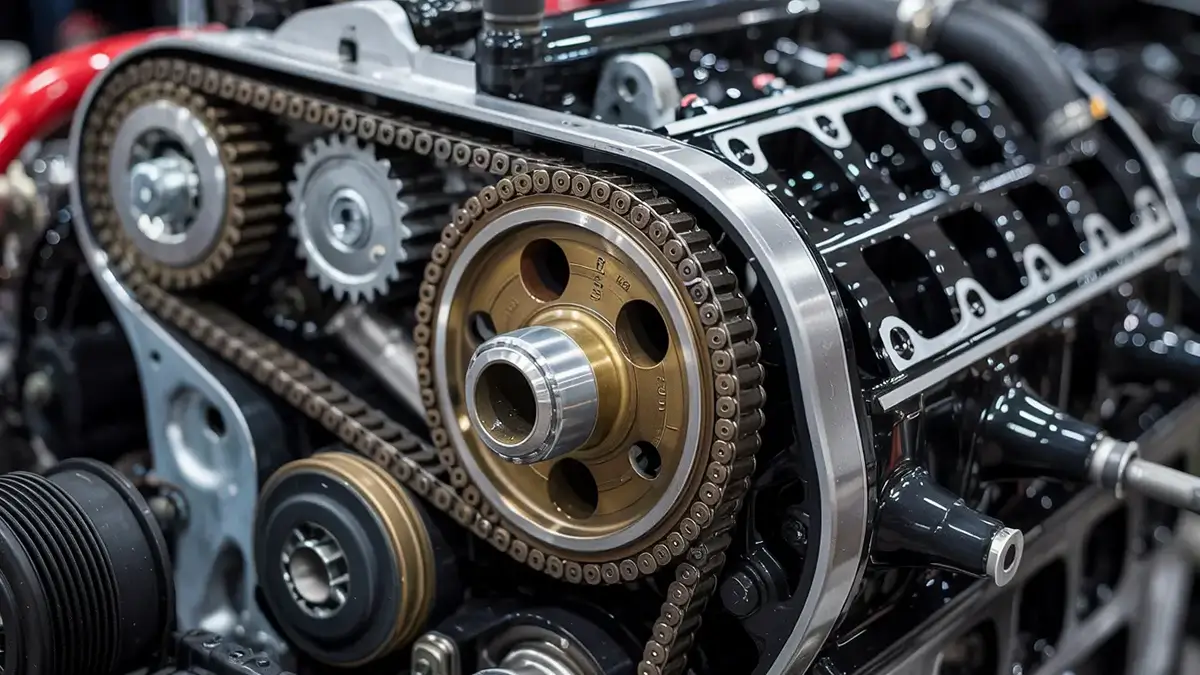
The engine timing system plays a crucial role in the engine's operation. It allows the camshaft to synchronise with the crankshaft, thereby controlling the intake and exhaust valves according to the engine's position.
It is also responsible for driving the water pump, which is one of the main components of the engine's cooling system. In other words, proper timing is essential for the engine, and its maintenance must be strictly adhered to.
If there is an issue with your timing system, your engine will be at significant risk. If the timing belt breaks while the engine is running, it will generally result in engine failure. When the valve collides with the piston, the damage will be severe.
The damper pulley: what is its role?
Let us remind you a bit about how the engine works. It consists of a piston and a crankshaft. These pistons drive the crankshaft, which in turn drives the wheels. The piston's movement powers engine accessories, such as a battery or an alternator. These parts are connected to the crankshaft by belts, also known as accessory belts.
The damper pulley functions to eliminate resistance and vibrations from accessories: air conditioning compressors, power steering pumps, and even alternators. It is directly connected to the crankshaft and uses it to drive the accessory belt.
Crankshaft: Everything you need to know about this central engine part!
What is a crankshaft? Etymologically, the crankshaft derives from the Dutch word meaning "spiral drill". A drill is a tool used to bore holes into materials such as soil or wood.
Today, the same mechanism is used in our car engines. With the help of a connecting rod, the piston's linear motion can be converted into continuous rotary motion, and vice versa.
For what purpose? The energy generated in the cylinder is transferred to the engine's output shaft.
Learn more about engine parts
Share this article