
The operation of spark plugs requires high-voltage current supplied by ignition coils. Their operation is quite complex, so testing them before replacing them remains the best solution to identify the problem.

What is an ignition coil?
The spark plug is an electrical device found in petrol engines designed to ignite the fuel in the cylinders so the vehicle can start. It is part of the engine distribution system.
Its particularly complex structure allows it to generate a spark powerful enough to trigger the combustion of the air-fuel mixture.
Thus, there are as many spark plugs as there are cylinders. Typically, French cars have 4 cylinders, and therefore 4 spark plugs.
It is important to note that if the air-fuel mixture is not optimal, the vehicle will pollute more, which could damage the catalytic converter and, consequently, the lambda sensor.
Note that without the ignition coil, the spark plugs cannot function as they will not be supplied with electricity.
How does an ignition coil work?
Spark plugs have a different role compared to glow plugs in diesel engines. Unlike their counterparts, they are essential for the engine's operation, not just during its start-up.
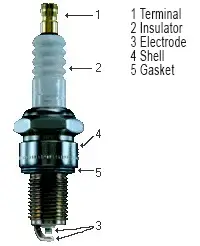
The operating principle is as follows:
- The ignition coil emits a very high voltage that flows inside the spark plug, entering through the connection terminal designed for this purpose (ignition harness).
- The electricity then flows to the central electrode and subsequently reaches the so-called "ground electrode" (at the cylinder head and base), producing a spark in the gap between these two electrodes.
Of course, numerous elements ensure the safety of this operation within the spark plug, guaranteeing insulation and sealing (ceramic, double O-ring, metallic base, and threading).
What is the purpose of an ignition coil?
The ignition coil is an essential component for the operation of spark plugs. Without it, the spark plugs are not supplied with electricity, and as a result, the car simply will not start (no spark production).
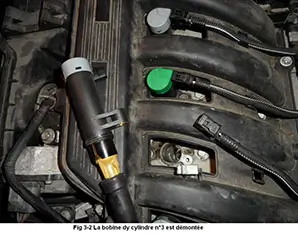
Its operation relies on an electromagnetic phenomenon occurring inside between the "primary" coil (12 volts) and the "secondary" coil (1,000 to 30,000 volts) to generate a sufficiently powerful current. The car battery powers it via a dedicated connection.
The main function of ignition coils is to provide high voltage to the spark plugs so they can produce an electric arc.
There are several types of ignition coils depending on the vehicle make and model. Here are the most common ones:
- The "distributor rail" type coil: As the name suggests, it is rail-shaped and consists of 2 coils, each capable of powering 2 spark plugs. It is replaced as a single unit and is directly mounted on them.
- The "pencil" type coil: These are the most common. They are pencil-shaped to fit perfectly onto the spark plugs since they are directly mounted on them. There are as many as there are spark plugs.
Testing your ignition coils and spark plugs
First, the engine warning light may come on.
However, if you have read our articles, you know that this light can come on for a variety of reasons, such as the air flow meter or throttle body. It is then difficult to pinpoint the exact source of the problem.
This is where, instead of going to a garage for a diagnostic, you can do it yourself!
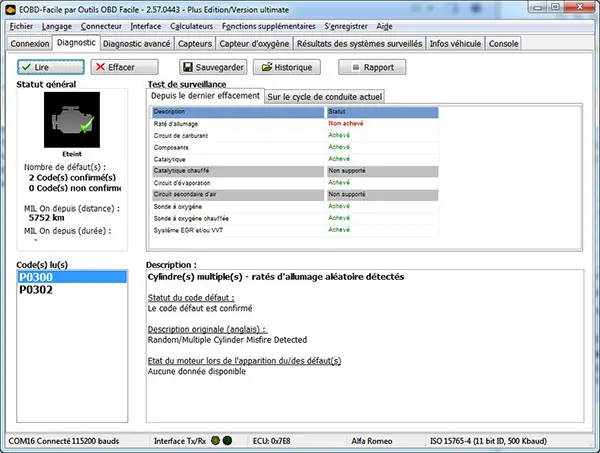
Equip yourself with a car diagnostic tool and read your fault codes to determine the exact problem!
Note that the fault codes corresponding to an ignition coil or spark plug issue may include (depending on the number of cylinders): P0301, P0302, P0303, P0304… This is referred to as misfires.
Should you replace your spark plugs or ignition coils?
Like all mechanical parts of a vehicle, ignition coils and spark plugs need to be replaced after a certain period.
Consequences of a faulty ignition coil
Ignition coils may also need replacing. If they are faulty, it will be noticeable in the vehicle's power and smoothness (operating on only part of the cylinders).
Note that this can even prevent the vehicle from starting if all the coils are defective (no spark to ignite the fuel).
If you notice any of these symptoms in your vehicle, it may indicate an issue with an ignition coil or a faulty spark plug.
Replacing spark plugs
Spark plugs generally need to be replaced every 30,000 to 60,000 kilometres (as recommended by manufacturers). It is necessary to replace all of them, even if only one is faulty, to avoid an imbalance in the ignition system.
Note that depending on the vehicle model, there may be 2 spark plugs per cylinder, in which case the pair must be replaced.
As explained earlier, poor spark plug condition can lead to increased pollution (engine lacking power, excessive fuel consumption)... If you fail to meet European environmental standards, you may be required to undergo a re-inspection during the technical control!
What are the other components of the distribution system?
Share this article