
The accelerator position sensor measures the pressure applied to the accelerator pedal to adjust the vehicle's speed accordingly, making its role essential.
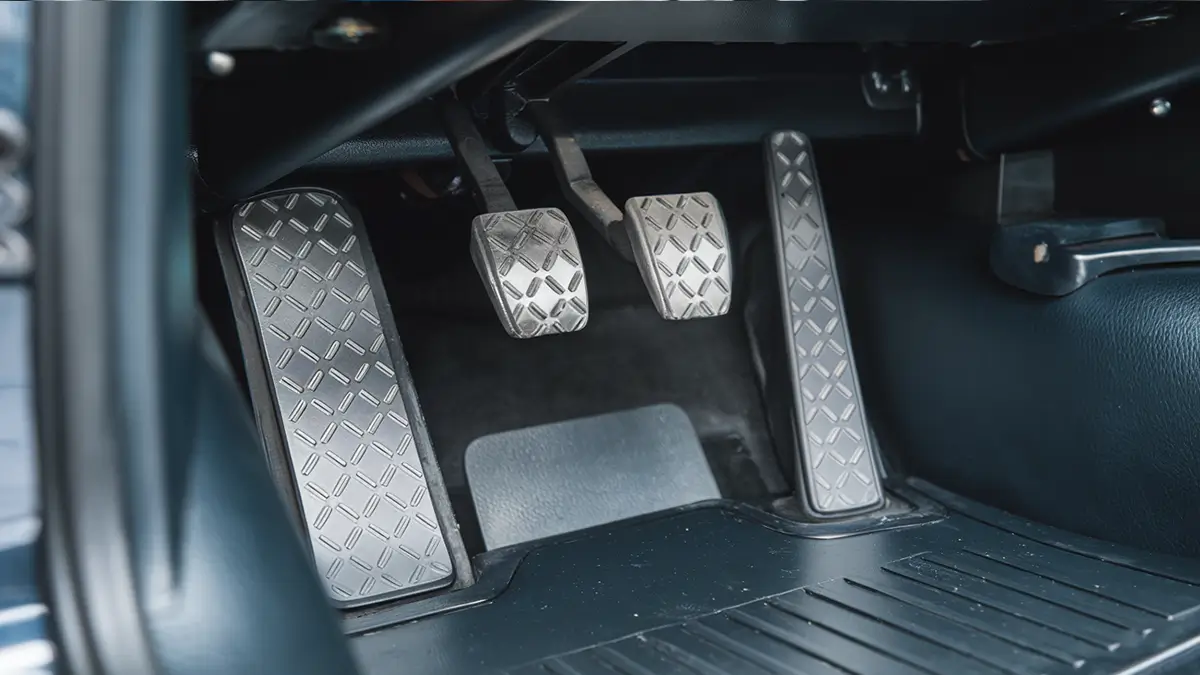
Role and development
The purpose of the acceleration sensor is to measure the pressure applied to the accelerator pedal in order to adjust the engine's load/power and its intake, and consequently the vehicle's speed.
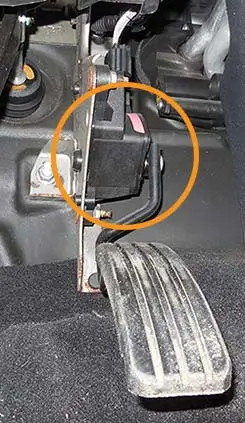
Note that for older vehicles, the connection is made via a mechanical accelerator cable.
Operation
The data measured by the accelerator position sensor is then transmitted to the engine control unit, which, using other information provided by the lambda sensor and the air flow meter, can manage fuel injection and air intake (throttle body) to achieve an optimal air-fuel ratio.
If a cruise control system is present, it is connected to the accelerator pedal sensor to automatically manage acceleration and deceleration.
The position sensor sends a signal to the control unit in the form of a continuous voltage. This voltage is generated by a potentiometer system powered by the control unit (usually with a 5-volt current).
Faulty accelerator position sensor
The acceleration sensor, like other sensors, can become faulty. Dirt or physical damage can impair its function. The accelerator pedal itself can also be defective.
It is therefore important to carefully analyse the symptoms to determine whether the issue lies with the sensor or the pedal...
The symptoms of a faulty accelerator pedal are, in most cases, the result of a defective position sensor...
Indeed, if it malfunctions, it will send incorrect data to the control unit, causing a mismatch between the pressure applied to the accelerator pedal and the vehicle's speed.
The engine's RPM may be affected, as well as the engine's response. Overall, the car will not respond properly to the driver, which can be dangerous for their safety and that of others.
The engine warning light on the dashboard may illuminate, and the control unit may switch the engine to "limp mode" to reduce risks... However, this may lead to faster wear of certain mechanical parts such as the EGR valve or the particulate filter (DPF)!
So, if you feel that your car is not responding as it should, pay close attention to its behaviour during acceleration and deceleration. If you notice articulation issues or occasional small blockages, the problem may simply be with the accelerator pedal.
Of course, these symptoms are difficult to detect and especially to attribute to an issue with the position sensor or accelerator pedal...
Diagnosing the acceleration sensor
How to determine if this sensor is the problem?
The best way to pinpoint the source of the problem and potentially the reason for the engine warning light is to perform a car diagnostic.
No need to visit a garage for this; you can do it yourself with a klavkarr diagnostic tool, which will allow you to read and clear engine fault codes.
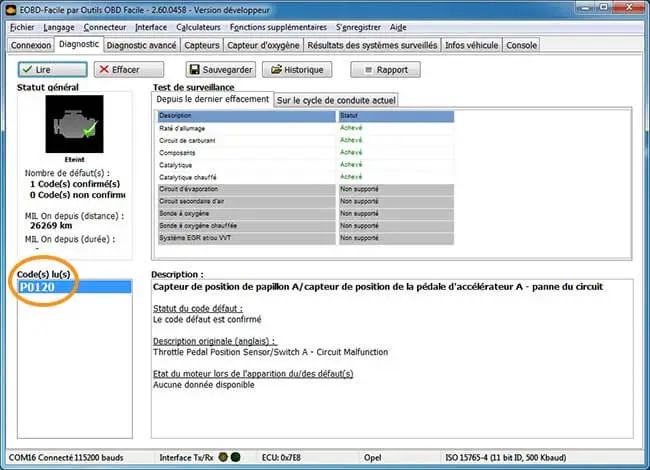
Here, we notice that code P0120 is indicated, which may correspond to an issue with the throttle body or the accelerator pedal sensor. It is likely a cable system, in which case the sensor is located at the throttle body.
Other fault codes exist, corresponding to performance issues or values that are too high or too low (P0121, P0122, P0123, P0124).
It is, in any case, useful to complement this diagnostic with a sensor test.
Testing the position sensor
As it is an electronic component, it is entirely possible to perform current tests on the accelerator pedal sensor using a multimeter.
When the vehicle is powered on, the voltage should range between 4.5V and 5.5V.
You can also check the output signal when accelerating; the voltage should vary between 0.15V and 4.7V depending on the position of the accelerator pedal: The more you press it, the stronger the signal.
Other articles you might find interesting
Share this article