
OBD2 DTC fault codes indicate issues detected by your vehicle’s engine ECU. With a compatible OBD2 automotive diagnostic scanner or a free app, you can read, interpret and clear confirmed, pending or permanent codes. This guide explains what they mean, how to read and clear them, and how to understand MIL status.
Models covered: All petrol vehicles since 2001 and diesel vehicles since 2004 equipped with an OBD2 port (Renault, Peugeot, Citroën, Ford, Volkswagen, BMW, Mercedes, Audi, etc.).
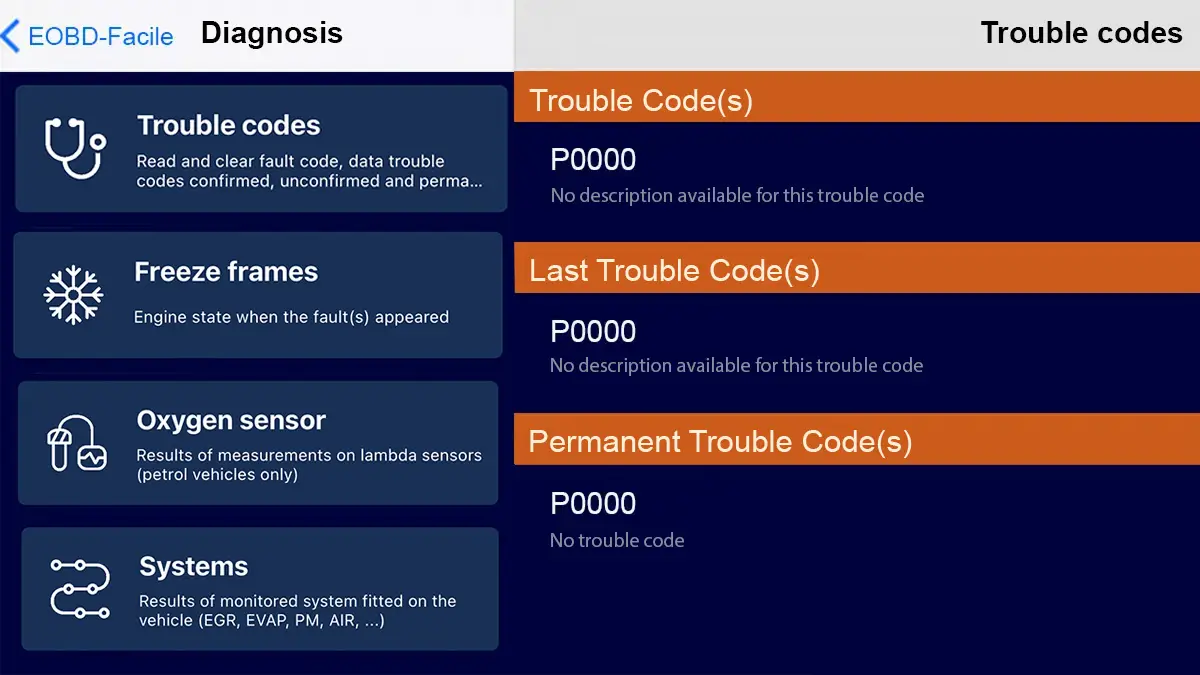
What is an OBD DTC fault code?
A fault code or DTC (Diagnostic Trouble Code) is a letter followed by numbers that correspond to a problem detected by your vehicle’s onboard OBD diagnostic system. DTCs precisely identify the nature and source of a fault affecting the engine, transmission (gearbox) or another electronic system.
The different DTC categories
The first letter of the code indicates the system group concerned:
- P: engine and transmission (Powertrain)
- C: chassis and safety systems (ABS, ESC, airbag)
- B: body and equipment (Body)
- U: communication networks between control units (Network)
The meaning of letters P, C, B and U
The digit after the letter shows whether the DTC is generic (=0) or manufacturer-specific (=1). The next three digits define the fault sub-family and the exact component affected.
In OBD2 diagnostics, P-type codes are the most common because they relate to the engine and transmission. All generic codes (P0) have a universal definition translated into French in our EOBD-Facile OBD2 diagnostic software. Manufacturer-specific code definitions (P1) are added over time, and major brands are already well covered (Renault, Peugeot, Citroën, Ford, Volkswagen, BMW, Mercedes).
Reading and clearing OBD2 fault codes
During an OBD2 diagnostic, you scan the engine ECU using a device or diagnostic interface to read any stored DTCs. These codes are sorted into different categories based on a specific operating logic.
How to read codes with and without a diagnostic scanner
There are several ways to read your car’s OBD2 fault codes:
- With a professional diagnostic scanner: a complete device that reads, interprets and clears DTCs
- With a Bluetooth OBD2 adapter: an interface that connects to your smartphone via a free or paid app
- Without a scanner, using self-diagnosis: some vehicles display codes via a specific dashboard procedure
Free tools to read fault codes
To read fault codes for free, you can use an affordable OBD2 adapter (from €15–20) with a free mobile app. This solution lets you read and interpret DTCs, clear non-permanent faults and monitor live engine parameters. Free apps generally provide the core OBD2 diagnostic functions.
Confirmed, pending and permanent codes: what’s the difference?
With EOBD-Facile, you’ll see DTCs grouped into three distinct categories:
- Confirmed codes (CT DTC or Confirmed DTC)
- Pending codes (PD DTC or Pending DTC)
- Permanent codes (cannot be cleared manually)
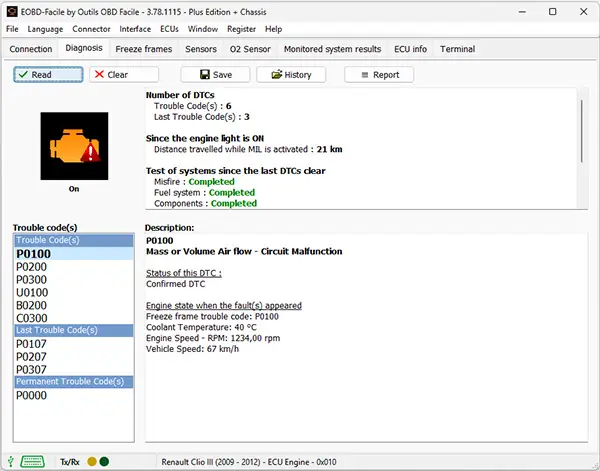
How a DTC becomes confirmed
This classification follows a specific operating process illustrated below.
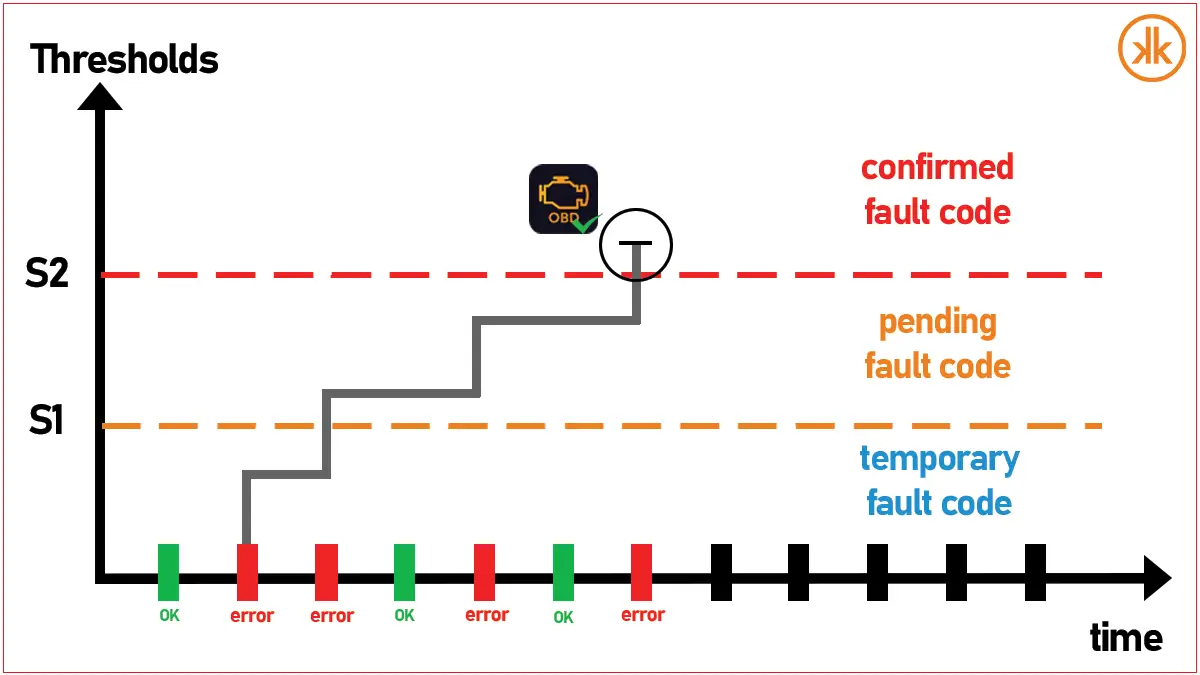
Everything depends on how often the fault is detected during the ECU’s continuous monitoring.
When a fault occurs during a drive cycle, it’s first considered “volatile” or “intermittent”. If it doesn’t recur frequently enough to pass the first detection threshold, it won’t be stored and will clear automatically at the end of the drive cycle (engine off).
If the fault recurs at a certain frequency and under specific conditions, it crosses the first threshold and becomes a pending code (PD DTC). The same logic applies to cross the second threshold and become a confirmed code (CT DTC). This is why a confirmed code will also appear in the pending list: it has passed both programmed thresholds.
In this way, false or occasional errors are filtered to avoid excessive warnings caused by a poor contact, intermittent glitch or other minor, temporary issue. Checks are also run under specific conditions to be representative (typically with the engine at normal operating temperature and engine speed above 1,000 rpm).
A pending code is an early warning: monitor it to prevent a failure before it becomes confirmed and triggers the engine warning light.
Permanent codes: why can’t they be cleared?
Permanent fault codes are a special category in OBD2 diagnostics. They are called permanent because they cannot be cleared manually, even with a professional diagnostic scanner. This is a safety feature, not a malfunction.
A permanent code appears when a fault affects vehicle emissions. The engine ECU keeps it in memory to ensure the problem is genuinely fixed. Only the ECU can automatically remove a permanent code after checking over several consecutive drive cycles (generally 40 to 80 cycles) that the fault is no longer detected and parameters are back to normal.
If you try to clear a permanent code, it will reappear at the next read. The only solution is to repair the root cause and allow the system to confirm automatically that the fault has gone.
MIL status and interpreting fault codes
Understanding the MIL and its statuses
Only a confirmed fault code can switch on the engine warning light. The MIL (Malfunction Indicator Lamp) is the amber, engine-shaped lamp on your dashboard.
However, not all confirmed codes will necessarily light the MIL. This depends on several factors such as fault severity, emissions impact and the number of detection cycles. MIL status indicates whether a DTC has requested the lamp to be lit.
Depending on the make and model, EOBD-Facile Edition Plus may provide detailed statuses, helping you see which code requested the MIL and interpret the situation more accurately.
PD DTC and CT DTC: pending vs confirmed codes
In OBD2 terminology you’ll often see PD DTC and CT DTC:
- PD DTC (Pending DTC): a detected but not yet frequent enough fault to be confirmed
- CT DTC (Confirmed DTC): a fault detected repeatedly and validated by the ECU
Other fault information may also be available when reading DTCs. Several data points are captured at the exact moment the fault occurs: freeze frame data, sensor values and engine operating conditions. It’s very useful to save all these data before repairing and clearing the fault, because clearing will permanently delete this complementary information that helps with interpretation and diagnosis.
Methodology for effective OBD diagnostics
To be efficient when carrying out OBD2 diagnostics, follow a clear method to fully confirm the repair and correctly clear the code.
Save data before clearing
First, always save your data during the first DTC read. You can even print a full report if you want the data to hand during your work.
This way, when you clear any fault codes, you still have your previous diagnostic data available. That can be very useful if a fault returns later or to compare values before and after repair.
Monitor pending codes
Another key point: pending DTCs (PD DTC). Knowing these codes at a given moment helps you anticipate and monitor a potential issue. A pending code can become confirmed later—unless you anticipate the problem and perform checks or preventive repairs beforehand.
Reading pending codes is also very useful after clearing a confirmed code to verify that the repair was truly effective. If a pending code reappears quickly, the issue isn’t fully resolved.
This structured approach to investigation and interpretation helps you target the repair efficiently and avoid replacing parts unnecessarily.
FAQ – Frequently asked questions about fault codes
What does DTC mean in automotive diagnostics?
DTC stands for “Diagnostic Trouble Code”. It is a standardised OBD2 code that precisely identifies a fault detected by the engine ECU or another electronic system in the vehicle.
What’s the difference between a confirmed and a pending code?
A pending code (PD DTC) is a detected fault that isn’t frequent enough to be validated, while a confirmed code (CT DTC) is a repeatedly detected fault that has crossed the ECU’s confirmation thresholds. Only a confirmed code can trigger the engine warning light.
How can I clear an OBD2 fault code for free?
You can clear an OBD2 fault code for free using an affordable OBD2 adapter (€15–20) connected to a free mobile app on your smartphone. This setup can clear confirmed and pending codes, but not permanent codes, which require the fault to disappear naturally and be verified by the ECU over several drive cycles.
Why are some permanent fault codes impossible to clear?
Permanent fault codes cannot be cleared manually because they relate to issues affecting emissions. Only the engine ECU can remove them automatically after 40 to 80 drive cycles without detecting the fault, confirming the problem has been definitively resolved.
Learn more
Share this article