
The coolant temperature sensor plays a crucial role in engine operation. If it fails, it can cause irreversible damage…
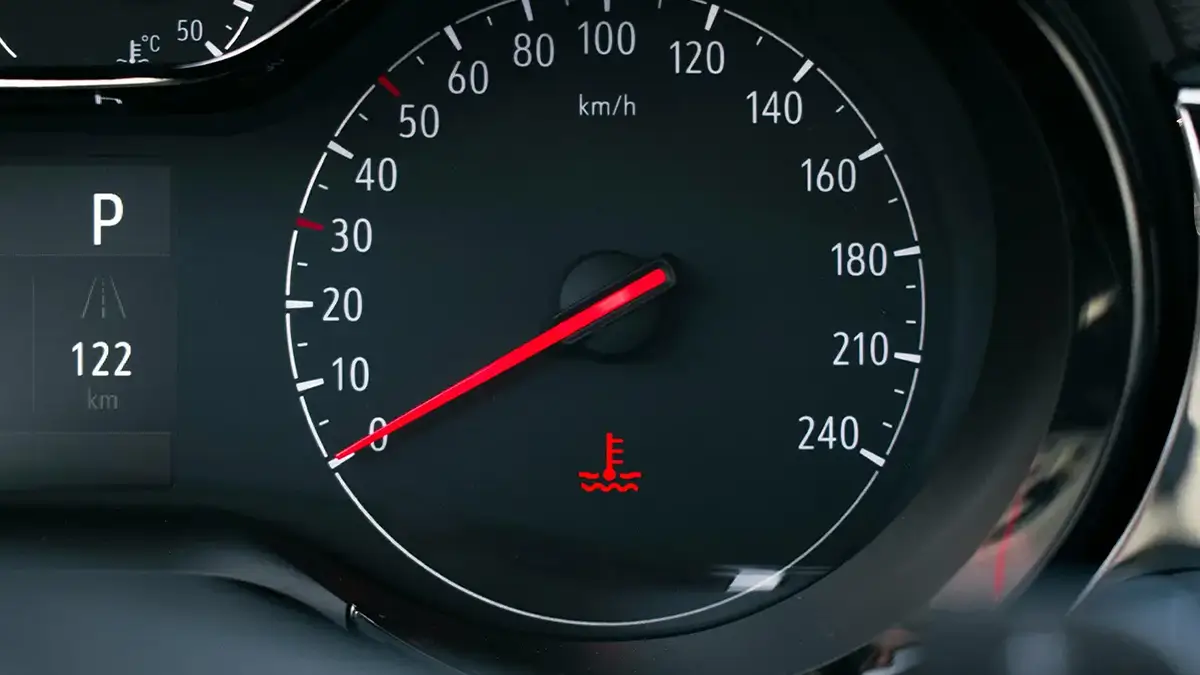
What is this sensor for?
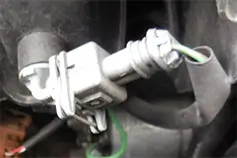
This temperature sensor is designed to measure the coolant temperature and warn the driver in case of overheating by triggering a specific red warning light (coolant warning light).
It is also referred to as a coolant temperature sensor or engine temperature sensor.
In any case, it plays an essential role in the cooling system, since the measured temperature is a key factor in proper engine operation.
Note that there is also a temperature sensor for intake air.
How the sensor works
The temperature measured by the sensor is sent to the ECU, which, based on this and other inputs (throttle pedal sensor, throttle body, oxygen sensor), adjusts the air-fuel mixture as precisely as possible.
The sensor itself works using a platinum resistance system known as a Pt100 sensor, based on the technology used.
It is located in the cooling circuit near the cylinder head — where coolant temperature is highest — to ensure reliable readings. It typically has 2 wires and receives around 5 volts, which drops progressively as the engine heats up.
To prevent overheating, the cooling system includes other components (thermostat and fan switch) to manage coolant temperature as accurately as possible.
Coolant warning light
What are the risks?
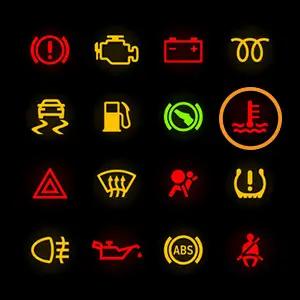
Warning! Like any red warning light, you must stop the vehicle immediately.
Overheating can cause serious engine damage if you keep driving.
This warning is often caused by a faulty temperature sensor sending incorrect data to the ECU, which can then affect the entire cooling system. Replacing a thermostat costs around €150, but a blown head gasket can range from €450 to €1200!
Additionally, the engine may enter "limp mode", leading to other issues (forced fan operation, limited RPM...) and causing accelerated wear on components like the EGR valve or catalytic converter.
In short, if this light comes on, stop safely right away. Paying for roadside assistance is far cheaper than damaging your engine.
Coolant level warning light
Many modern vehicles also have a second warning light for low coolant level. It is triggered by a sensor when the level drops below a threshold. Check the level visually and top it up if needed. If the level is fine, the sensor might be faulty.
If this light turns on repeatedly, you likely have a coolant leak. Have the entire system checked (hoses, head gasket, etc.).
How to test the temperature sensor
It's difficult to assess the condition of a temperature sensor. Related issues are hard to detect and often show up alongside the red overheating warning light (when limp mode is activated).
Run a vehicle diagnostic
You can perform a vehicle diagnostic using a Klavkarr Car Diagnostics Scanner.
Below, the fault code P0115 appears — indicating a cooling system circuit malfunction, which may explain the red warning light triggered by overheating.
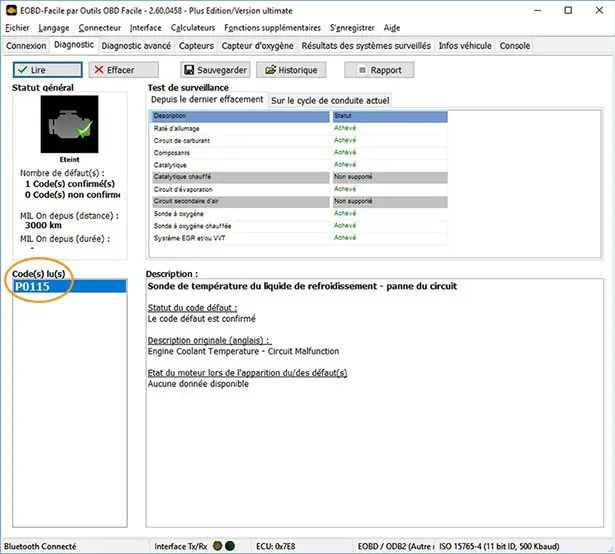
Then, in the “Sensors” tab of the EOBD-Facile software, you can check the coolant temperature directly — this may save you from using a multimeter.
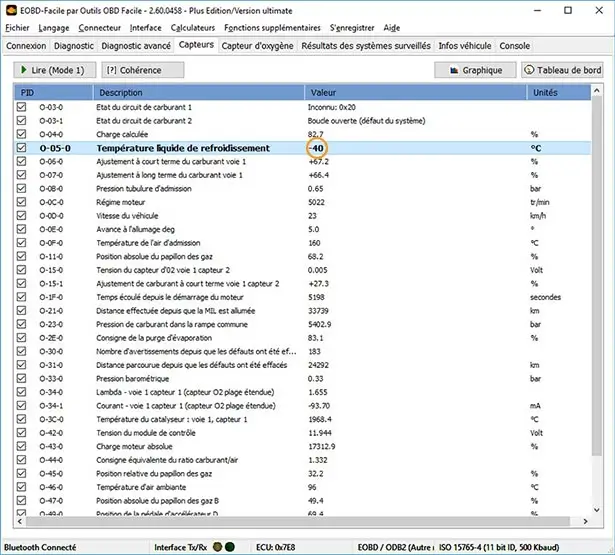
In this example, the value shown is -40°C, which clearly indicates a problem with the temperature sensor. You can visually inspect the wiring and connector.
Testing with a multimeter
It's also possible to check how the sensor reacts to temperature changes using a multimeter. Measure its resistance (in ohms, Ω), and compare it to a reference table to estimate the corresponding temperature.
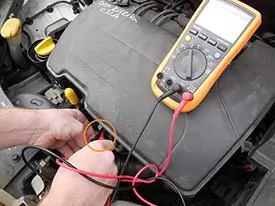
The lower the resistance, the higher the temperature. At 0 Ω, the temperature is around 120°C or more; at 3000 Ω, it's between 25°C and 35°C.
The ideal engine temperature is around 88°C. Values between 85°C and 100°C are acceptable — anything above may indicate overheating.
Before testing with a multimeter, make sure the sensor is not powered. Disconnect it first to avoid skewed readings.
Replacing the temperature sensor
It’s entirely possible to replace the coolant temperature sensor yourself. First, make sure the engine is completely cool to avoid any risk from pressure.
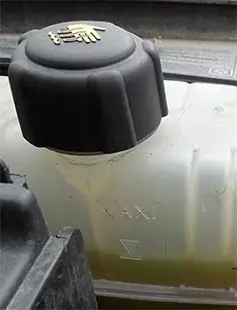
Then unscrew the sensor using a suitable tool, or unclip it depending on the type. Disconnect the electrical connector and remove the sensor and seal. You can clean the area with a cloth or scraper.
Finally, fit the new sensor and reconnect the wiring. Check the coolant level and top it up if needed. It’s generally recommended to bleed the cooling system afterward.
Coolant temperature sensors are not expensive — expect to pay between €10 and €20 depending on the brand.
Learn more about the cooling system
Share this article