
The particulate filter, commonly known as the DPF, is an anti-pollution device that complements the EGR valve in the exhaust system. Like the EGR valve, it requires cleaning: this is referred to as DPF regeneration.
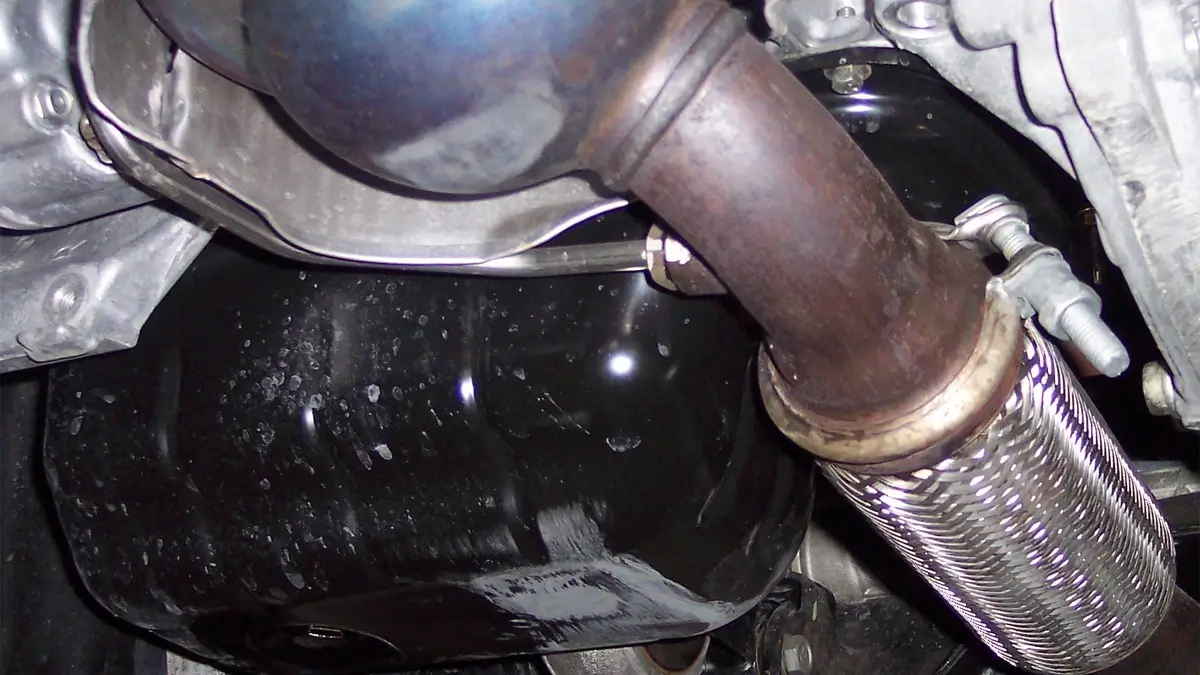
What is a car's particulate filter?
The particulate filter (DPF) of a car is a device designed to reduce the emission of hydrocarbon and carbon particles from diesel engines. It complies with European Union environmental standards.
Its operation is based on a gas heating system to trap particles emitted by the car's engine, which are then burned later. Soot accumulates inside the particulate filter, which can clog the DPF and damage the system as well as the engine.
This device complements the EGR valve to clean exhaust gases.
Why clean the DPF?
Soot particles that gradually accumulate in the DPF must be burned off as they can hinder its proper functioning and cause malfunctions in your car.
This can manifest as the DPF warning light and/or the engine warning light turning on. Your vehicle may then switch to "limp mode", which results in reduced engine performance (frequent stalling, limited power, maximum speed restriction, etc.).
You can also easily diagnose this issue using our klavkarr diagnostic tool!
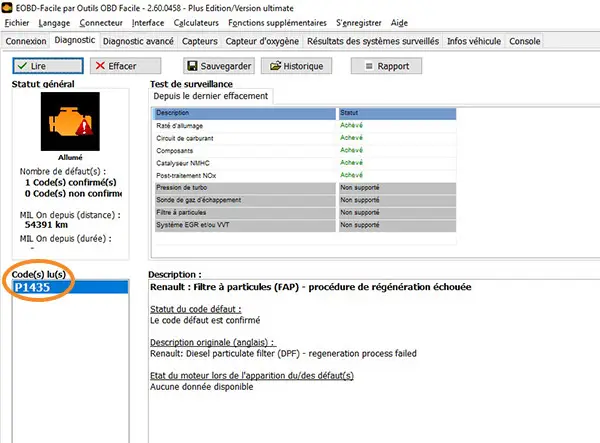
Here, the code P1435 is specific to Renault. The generic code is P24A4.
If the filter is clogged, it will become ineffective, and you will pollute more. Be cautious during your vehicle's MOT test!
To solve this issue, it is necessary to perform a DPF cleaning. An automatic regeneration system has been implemented by car manufacturers to address this problem...
What is DPF regeneration?
Passive regeneration
DPF regeneration refers to an automatic system or specific process that allows for the cleaning of the particulate filter by burning off the trapped soot layer.
This process requires a very high temperature (between 550 and 650 degrees), which can be problematic for cars driving in urban areas or on short trips: the engine may struggle to run at high revs. The engine needs to run at around 3000 rpm to reach the required temperature and trigger regeneration.
Thus, if you have the opportunity to drive at high engine revs for 15-20 minutes from time to time, do so!
This is the most "natural" way to burn off the particles in the DPF, referred to as passive regeneration.
Active or controlled regeneration
Once a certain clogging threshold is reached (around 18g), the engine control unit triggers active regeneration of the car's particulate filter.
This saturation level is calculated based on several factors:
- Your driving style
- The pressure difference between the inlet and outlet of the filter (degree of blockage)
- The exhaust gas temperature
- The Lambda sensor temperature
Once the temperature is reached, active regeneration starts to clean your DPF. The goal is to increase the exhaust gas temperature to facilitate regeneration (550 / 650 degrees).
To achieve this, the control unit performs various operations: shutting off the EGR valve, activating post-injection, controlling the turbo, etc.
Forced DPF regeneration
If the saturation level reaches around 24 grams, the DPF warning light turns on! This indicator alerts you to a problem with the filter's regeneration.
It is strongly recommended to complete a full regeneration drive (high engine revs over a certain distance) to clean it, or you may need to visit a workshop...
Workshop regeneration
From a clogging threshold of 40 grams (failed forced regeneration), the engine warning light and even the preheating indicator light turn on in addition to the DPF warning light. Active regeneration is then blocked to prevent any damage to the filter. A visit to your dealer is therefore necessary to perform a complete cleaning.
It is important to act quickly because without a regeneration system, your car's particulate filter can continue to clog, which can be fatal if the saturation level exceeds 45 grams!
Mileage-based regeneration
Finally, the engine control unit automatically triggers active DPF regeneration if no regeneration has been performed in the last 750-1000 kilometres.
This program is entirely independent of the clogging level and serves as an additional safety measure.
After regenerating your DPF, remember to check your car's engine oil level and coolant level.
Proper maintenance of your car's particulate filter!
As you can see, monitoring the condition of your filter and responding accordingly will save you a lot of money!
This type of DPF (oxidation filter) does not necessarily require specific maintenance but only regular checks (frequency of regenerations) and adopting an appropriate driving style.
Theoretically, the lifespan of the particulate filter matches that of the car. Although this may seem optimistic, adopting good habits will maximise its longevity.
The additive DPF
There is, however, a second type of particulate filter: the additive DPF. Developed by PSA, this filter uses a mixture of iron oxide and cerium oxide called Eolys.
This additive is stored in a separate tank and mixes with the soot in the DPF. This accelerates combustion, allowing for regeneration at a lower temperature (450°C instead of 550°C). The regeneration process then takes no more than five minutes and limits fuel overconsumption.
This cleaning method is quite effective. However, the downside of this system is that you need to refill the Eolys additive approximately every 120,000 km.
Other articles you might find interesting
Share this article