
In an era of all-things connected and electric, pinpointing the cause of a car breakdown can be challenging and costly. However, with tools like a multibrand car diagnostic scanner, you can run your own diagnosis and repair your car yourself.
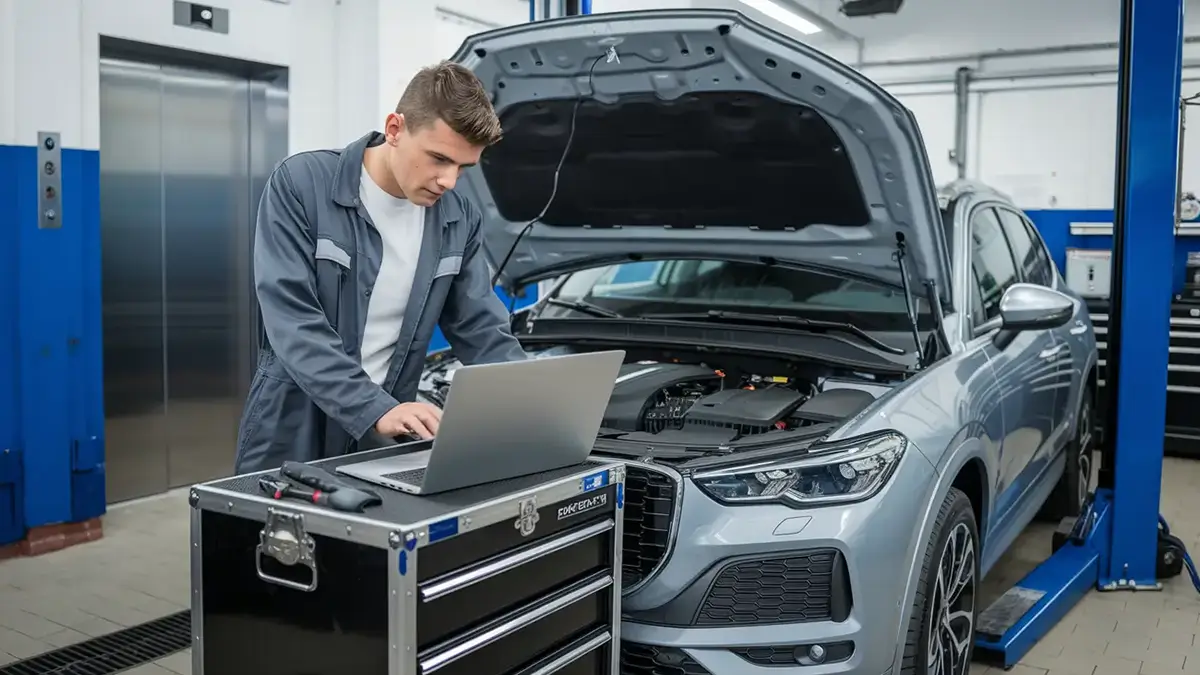
When should you use a diagnostic scanner?
Automakers—from Renault and Peugeot to Ford, Citroën, Opel, BMW, and Volkswagen—integrate more and more electronic components into their models. As a result, it’s hard to diagnose an issue without using the mechanic’s trusty diagnostic scanner.
You can use a diagnostic scanner when you break down, but also when buying a used car, before a technical inspection, and more.
Which mechanical parts can be diagnosed by a scanner?
Capable of detecting virtually any car fault, it accurately pinpoints the source of the problem. Today, a wide range of diagnostic devices is available on the market.
As a result, any car owner can now purchase one of these scanners and interpret their vehicle’s faults on their own.
Which car diagnostic scanner model should you choose?
What types of diagnostic scanners are there?
There are numerous diagnostic scanner models for both professionals and DIY enthusiasts.
The first question to ask is: “What will I use it for?” If you plan to diagnose multiple makes—Dacia, Fiat, Mazda, and the like—we recommend a multibrand scanner. And if you need it for professional use, a multibrand scanner is essential.
However, if you only need to diagnose a single make, you can choose a manufacturer-specific scanner. Just keep in mind you might switch cars or help friends in the future—so a multibrand scanner can save you from buying another one later.
The multibrand diagnostic unit
These scanners range from basic to advanced. Universal units adapt to all vehicle makes and models. Entry-level units feature a black-and-white screen and simple navigation buttons.
Modern diagnostic scanners offer far more advanced features.
Why use a car diagnostic scanner?
Still wondering why you should use a diagnostic scanner?
Using a diagnostic scanner is vital for your car’s health. Routine scans let you monitor your engine, transmission, and immobilizer systems.
The scanner searches for faults. You can then perform repairs, clear fault codes, and reset the check-engine light.
You know the saying “An ounce of prevention is worth a pound of cure.” It applies to your car too. Regular diagnostics help you track component health before a warning light appears, preventing minor issues from becoming costly repairs.
Using a scanner is also invaluable when buying a used car—it reveals the vehicle’s identification number and any hidden faults.
The diagnostic interface and software
The market offers a wealth of diagnostic software and scanners. For convenience, you can purchase both together. Simply plug into your car’s OBD port and you’re ready.
When choosing, check vehicle compatibility and software language—many aren’t available in French.
If you buy a unit from China, watch for language and build quality. Usually in English, you may struggle if you don’t speak it—opt for French software if needed.
Prefer an OBDII reader that provides data in French and ships from France. Also check delivery times, as shipments from China can be lengthy.
Tip: For engine (emissions) and transmission diagnostics, gasoline cars from 2001 and diesel cars from 2004 onward are compatible.
How do these tools work?

See a warning light on your dashboard? It’s time to use your diagnostic scanner.
The scanner: plug the device into your car’s diagnostic port (OBD), located inside the cabin near the driver. Turn on the scanner and start the engine. Within minutes, it detects the fault and displays the error code with details.
The diagnostic software/app: connect the scanner to your computer or smartphone (Android or iPhone). Launch the app and turn on the ignition. You can then begin analyzing the fault. The software explains the issue and lets you clear the code and reset the check-engine light.
Save money by using your scanner
By investing in a car diagnostic tool, you save on vehicle maintenance. With a diagnostic device, you instantly know the nature of the fault. For small tasks—cabin filter changes, battery replacements, spark plug swaps—you can do it yourself.
Doing the work yourself instead of going to a garage can save you hundreds of euros.
If you’re not handy or it’s a major issue, take it to a garage. They’ll diagnose and repair your car safely.
You might wonder why own a scanner if you’re not a DIYer. Even if you can’t fix it, knowing the exact fault stops mechanics from inventing extra issues—you’ll know exactly which part is faulty (MAF sensor, lambda probe, EGR valve, DPF, glow plugs, etc.), avoiding exorbitant bills.
Tip: When buying a used car, bring your scanner for a quick pre-purchase check.
How much do these devices cost?
Which diagnostic scanner should you buy?
Scanner prices vary widely. Entry-level units without software start at €15. More complete OBD2 units range from €60–120. High-end scanners cost over €1000, even several thousand for top models. Generally, higher price means more features, but mid-range scanners suffice for most needs.
Choose your device based on how often you’ll use it.
For more on DIY car repairs
Share this article