
The VIN number, or Vehicle Identification Number, is a series of characters used to distinguish all vehicles worldwide. You can find this number in several places on your car, and it is essential for certain administrative procedures.
A unique series of characters for each car, it is now mandatory for every vehicle to have the VIN number indicated. The use of a diagnostic tool can help locate it.
Want to learn more about this number? Sit back and take the time to read our comprehensive guide on the subject.
What is a VIN number?
What does the VIN number mean for your car?
The acronym VIN comes from the English term Vehicle Identification Number. Some people also use the term "chassis number", or may refer to it as NSV (Vehicle Serial Number) or NST (Serial Number in the Type).
Simply put, if we were to briefly summarise what a VIN is, it is a 17-character alphanumeric code, first experimented with in the USA in 1954. It became universally standardised for all vehicles worldwide in 1981.
This code allows you to distinguish all vehicles worldwide. Each code is unique and corresponds to a specific car. This combination of letters and numbers is assigned to the vehicle by the manufacturer. This process is valid worldwide, whether you are in America, Africa, Europe, or Asia, every vehicle will have its VIN number. This code is regulated by ISO standards.
How is a VIN code structured?
After a quick definition and a brief historical reminder about the VIN number, it is time to delve into the heart of the matter by taking a closer look at the series of characters that make up the VIN.
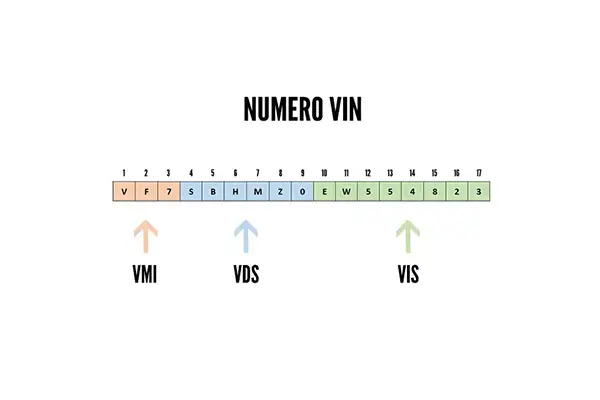
As previously mentioned, the VIN consists of 17 characters. Here is an example of what a VIN number might look like: VF7 SBHMZ0 EW554823.
This code is made up of parts that correspond to the manufacturer code (the WMI), the descriptor code (the VDS), and the indicator code (the VIS). Don't be intimidated by these terms; it is very easy to understand what they represent.
As a fun fact, the VIN number cannot contain the letters I, O, or Q to avoid confusion with the numbers 1 or 0.
The manufacturer code – WMI
The manufacturer code or WMI (World Manufacturer Identifier) identifies the geographical area of a specific vehicle. It is a series of 3 characters found at the beginning of the VIN number.
- The first character indicates the geographical area, for example, the letter V corresponds to the grouping of France, Spain, or Croatia. The number 1, on the other hand, corresponds to the United States.
- The second character goes further into detail, as it represents a specific country within the geographical area. For example, for France, it would be the letter F.
- The last character corresponds to a specific manufacturer, a choice made by an authority specific to each country. For example, in France, the number 1 corresponds to Renault, 3 to Peugeot, and 7 to Citroën.
Below, you will find the WMI codes for the most common brands in France.
| WMI Code | Brand |
|---|---|
| 1B3 | Dodge |
| 1C4 | Jeep |
| 1FA | Ford |
| 4S3 | Subaru |
| 5FN | Honda |
| 5GT | Hummer |
| 5TD | Toyota |
| JF1 | Subaru |
| JMA | Mitsubishi |
| JMZ | Mazda |
| JTD | Toyota |
| KL1 | Chevrolet |
| KND | Kia |
| KPA | Ssangyong |
| SAL | Landrover |
| SJN | Nissan |
| TMB | Skoda |
| UU1 | Dacia |
| VF1 | Renault |
| VF3 | Peugeot |
| VF7 | Citroën |
| VWV | Volkswagen |
| W0L | Opel |
| WBA | BMW |
| WDA | Mercedes |
| WDB | Mercedes |
| WF0 | Ford |
| WME | Smart |
| WMW | Mini |
| WP0 | Porsche |
| WVW | Volkswagen |
The vehicle descriptor section (VDS)
The VDS (Vehicle Descriptor Section) is the middle part of the VIN number and consists of 6 characters. The first 5 characters identify the vehicle's specifications and configuration, while the 6th character indicates the vehicle's trim level or, for vehicles sold on the North American market, the check digit. The check digit can be calculated using VIN decoding tools, such as our EOBD-Facile software.
Unlike the WMI, which is relatively easy to identify and understand, obtaining detailed information about the VDS can be difficult because each manufacturer uses its own decoding system. For example, for PSA vehicles, it is similar to the vehicle type approval code.
The vehicle indicator section (VIS)
The final part of the VIN number is the VIS (Vehicle Indicator Section), which consists of the last 8 characters of the code. It is used to identify a specific vehicle among a range of similar models.
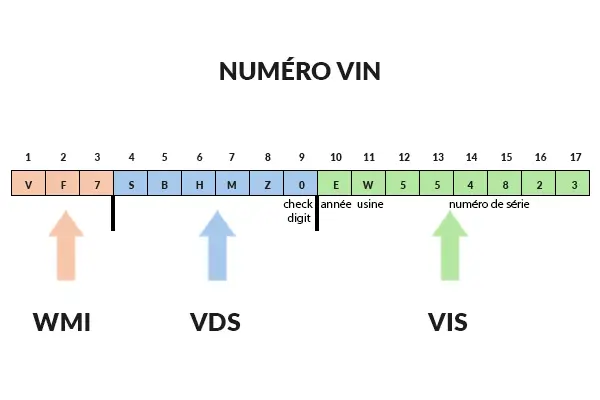
The first character of the VIS indicates the vehicle's model year. In the table opposite, you will find the year codes used from 2000 to 2026.
| Model year code | year |
|---|---|
| Y | 2000 |
| 1 | 2001 |
| 2 | 2002 |
| 3 | 2003 |
| 4 | 2004 |
| 5 | 2005 |
| 6 | 2006 |
| 7 | 2007 |
| 8 | 2008 |
| 9 | 2009 |
| A | 2010 |
| B | 2011 |
| C | 2012 |
| D | 2013 |
| E | 2014 |
| F | 2015 |
| G | 2016 |
| H | 2017 |
| J | 2018 |
| K | 2019 |
| L | 2020 |
| M | 2021 |
| N | 2022 |
| P | 2023 |
| R | 2024 |
| S | 2025 |
| T | 2026 |
The second character identifies the vehicle assembly plant. The final 6 characters define the vehicle serial number. This is a sequential number assigned to the vehicle as it leaves the factory.
What is my VIN number used for?
If you want to register your vehicle, your VIN number will be essential.
You now know how a VIN number is structured and why it is important. However, you may be wondering where to find it on your vehicle. That is exactly what we will cover in the second part of this guide.
Where can you find your VIN number?
On the vehicle
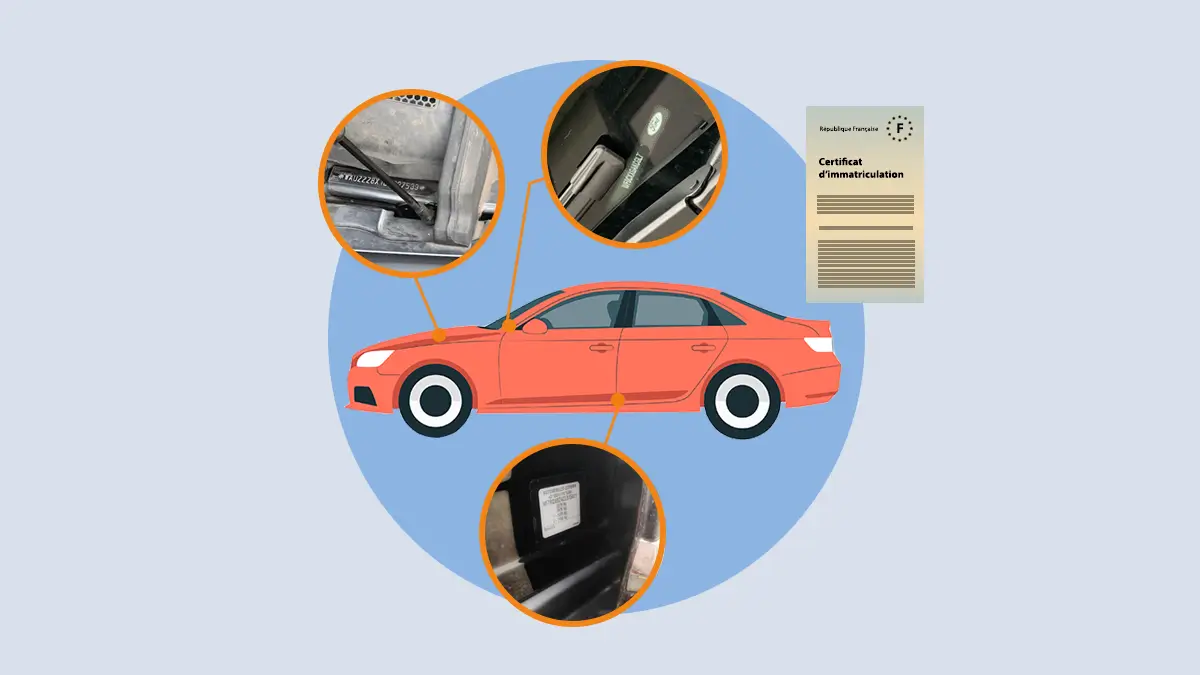
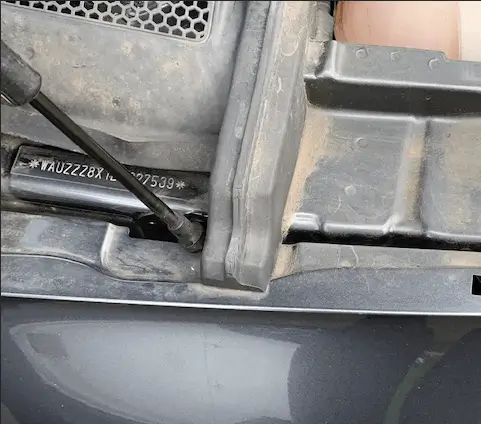
There are several places where you can find your VIN number on your vehicle. First, it may be stamped directly onto a structural part of the vehicle, such as the engine crossmember or a suspension strut tower. This is known as a VIN stamp on the chassis. This is why the VIN number is often referred to as the chassis number.
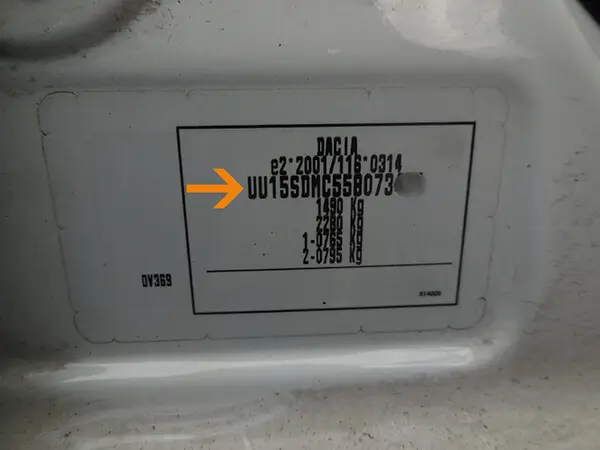
The VIN number can also be found on the vehicle identification plate. This plate, which is approximately 10 centimetres long, is usually located either on the door pillar or under the bonnet.
Please note that displaying the VIN number on both the vehicle identification plate and the chassis stamp is mandatory on all vehicles.
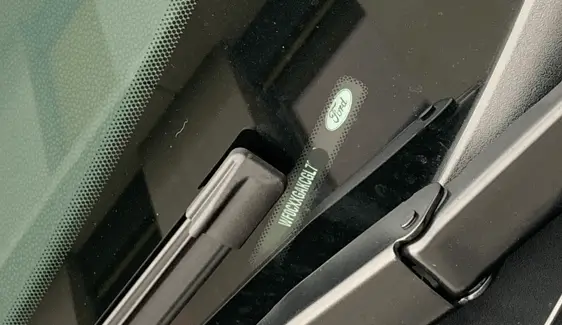
Finally, on some vehicles, the VIN number can also be found at the bottom of the windscreen.
On the vehicle registration certificate
Another very easy way to find your VIN number is to check your vehicle registration certificate. Wondering where the VIN number appears on the registration document? Simply look for field E, where you will find the VIN number.
Your VIN number will also be required when updating or replacing your vehicle registration certificate.
Tip: How to verify your VIN number with EOBD-Facile?
There is a way to find your VIN number while also ensuring that it has not been tampered with: by checking the VIN stored in your vehicle's Engine Control Unit (ECU).
How do you do this? Use a Klavkarr car diagnostics scanner and run a diagnostic with EOBD-Facile software. This is the solution we recommend, especially if you own or are planning to buy a used vehicle.
To do this, follow these steps:
- Turn on the ignition.
- Connect your Klavkarr to the OBD2 port.
- Launch the EOBD-Facile application.
- Select your vehicle make and model.
- Leave the "Engine ECU" and "OBD ECU" control units selected.
- Select "Engine ECU".
- Tap "ECU Information", then "Identification".
- Tap your VIN number to view all available information.
There is no need to manually decode every section of the VIN number to access the information you need. Your Klavkarr car diagnostics scanner does all the work for you! You can instantly view details such as the vehicle type and many other vehicle specifications. Convenient, isn't it?
If you are still having trouble following these instructions, we have created a video tutorial to help you.
Don't have a car diagnostics scanner? You can choose from our range of Klavkarr products to perform vehicle diagnostics at an affordable price!
My VIN number does not match my vehicle
Another advantage of this procedure is that the VIN number stored in the ECU is extremely difficult, if not impossible, to alter. This is not the case for VIN markings located elsewhere on the vehicle, which are easier to tamper with.
If you are buying a brand-new vehicle, this is unlikely to be a concern. However, if you own or plan to purchase a used vehicle, this simple check could save you from serious problems.
If you discover that the VIN number stored in the engine ECU differs from the VIN displayed elsewhere on the vehicle or from the one shown on the ownership transfer document, you should contact the relevant authorities as soon as possible (police or law enforcement) and report the issue.
Conclusion
To sum up, every vehicle has its own unique VIN number, which distinguishes it from every other vehicle in the world. You can find this number in several locations, including the chassis, the vehicle identification plate and, on some vehicles, at the base of the windscreen.
However, we strongly recommend verifying your VIN number directly through the ECU using a car diagnostics scanner, especially if you own or are considering buying a used vehicle. We hope that after reading this guide, you will never again ask yourself, "What is a VIN number?"
FAQ - What is the VIN number ?
Where can you find the VIN number on a car?
The VIN number is usually shown on the vehicle registration document in section E, on the manufacturer’s plate, on the chassis, or sometimes at the bottom of the windscreen. It can also be read from certain ECUs using a compatible Car Diagnostics Scanner.
How many characters does a VIN number have?
A VIN number has 17 characters made up of letters and numbers. The letters I, O and Q are not used to avoid confusion with the numbers 1 and 0.
What is a car’s VIN number used for?
The VIN number is used to precisely identify a vehicle. It is useful for vehicle registration, buying a used car, ordering spare parts, or checking the vehicle’s history.
What should you do if the VIN number does not match the car?
If the VIN number visible on the vehicle does not match the one on the vehicle registration document or in the engine control unit, you should avoid finalising the purchase and request a thorough inspection. If you have serious doubts, it is best to contact the relevant authorities.
Other articles that may interest you
Share this article