
The ESC light on Fiat, an orange indicator, signals an issue or intervention of the electronic stability control system. If it remains on after starting, it may be related to a loss of traction, a faulty ABS sensor, a battery issue, or an electronic fault. Before clearing the ESC light, it is important to identify the cause with a car diagnostic to avoid any safety risks for the vehicle.
Models concerned: 500, 500L, Panda, Punto, Grande Punto, Tipo, Doblo, Ducato, Fiorino, Qubo, Freemont - All petrol, diesel, and hybrid engines
What does the Fiat 500 ESC light or the one on other models of the brand look like?
Why does it light up?
How can it be cleared?

What is the ESC light on Fiat?
The role of the ESC system
ESC stands for Electronic Stability Control. This system helps the driver maintain control of the vehicle in case of a loss of traction.
It intervenes particularly when the car risks skidding in a curve, on a wet road, on snow, or during a sudden manoeuvre. The system can automatically act on the braking of one or more wheels and, depending on the model, temporarily reduce engine power.
Its objective is to maintain the vehicle's trajectory to minimise the risks of losing control.
ESC, ASR, VDC, and Hill Holder: what are the differences?
On some Fiat models, the ESC system can work with several other electronic driving aids, such as ESP, ASR, or Hill Holder.
ASR (Anti-Slip Regulation) corresponds to the vehicle's anti-skid system. It mainly intervenes during starts and accelerations. Its role is to limit the loss of traction of the driving wheels to reduce the risk of skidding. If a wheel starts spinning too fast compared to the others, the system can reduce the transmitted power or act on the braking to help the vehicle regain traction.
Hill Holder, also called hill start assist, prevents the vehicle from rolling back when restarting on a slope. The system automatically maintains braking for a few moments without the driver needing to use the handbrake. The brakes are then automatically released at the time of starting.
VDC (Vehicle Dynamic Control) refers to the system that monitors the trajectory, traction, and stability of the car, present on some Fiat models. The VDC compares the direction desired by the driver with the actual behaviour of the vehicle. If a loss of stability is detected, it can act on the braking of certain wheels and the engine power to help the vehicle stay on its trajectory.
These systems are often interconnected. This is why a fault in the ESC system can sometimes be accompanied by a message concerning ASR, ESP, VDC, or Hill Holder.
What does the Fiat ESC light look like?

The ESC light is generally represented by a car accompanied by skid marks or the acronym "ESC". It is often orange or yellow in colour.
Depending on the Fiat model, it may be accompanied by a dashboard message, for example:
- ESC not available,
- Hill Holder not available,
- ASR not available.
The exact wording depends on the model, year, and language configured in the onboard computer.
Fiat ESC light on: is it normal?
Flashing ESC light
When turning the ignition on, the temporary lighting of several indicators is normal. However, they should turn off after a few seconds, once the electronic checks are completed.
If the ESC light flashes briefly while driving, it generally means that the system is intervening.
This situation can occur in the following cases:
- Wet road,
- Curve taken too quickly,
- Acceleration on a slippery road,
- Temporary loss of traction,
- Emergency braking.
In this case, it is not necessarily a fault. The ESC system acts to stabilise the vehicle.
If the light flashes, it is recommended to adopt smoother driving. Gradually reduce your speed, avoid sudden accelerations, and increase safety distances. It is also advised to check the condition of the tyres, as their wear or incorrect pressure can promote traction loss.
Permanent ESC light
When the ESC light remains permanently on, the system usually signals a fault. It is no longer a simple temporary intervention related to a loss of traction but a defect detected by the vehicle's electronics.
In this situation, the stability control aid may be disabled or operate in a limited manner. The car can still be driven if its behaviour remains normal, but it will be less assisted in certain conditions, particularly on slippery roads, in curves, or during an emergency manoeuvre.
If the ESC light stays on with the engine running, a check is recommended. The problem's origin may come from a sensor, a weak battery, an electrical fault, or a component related to the braking system.
Can you drive with the Fiat ESC light on?
ESC light on alone
It is generally possible to drive with the ESC light on, provided the vehicle behaves normally and no red light is present.
However, you must remain cautious. The ESC system plays a role in your vehicle's safety. If it is disabled, the car may be harder to control in case of traction loss.
When the ESC light is on alone, you can continue your journey at a moderate speed, avoiding sudden accelerations and hard braking. It is then recommended to have the vehicle checked, especially if the light remains on after restarting.
ESC light on with other lights
If the ESC light appears with other lights, the situation must be analysed more carefully. The combination of several indicators often helps guide the diagnosis:

ESC light + ABS light: the fault may come from an ABS sensor, an electrical harness, or the ABS block. Stability control may be disabled as it uses wheel speed information.

ESC light + brake light: the issue may concern the braking system. Check the brake fluid level, the condition of the brake pads, and the pedal behaviour. If the brake light is red, stop safely as soon as possible.
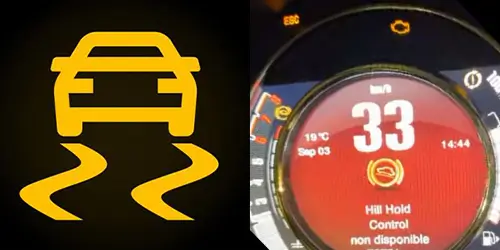
ESC light + Hill Holder unavailable message: hill start assist may be disabled. The cause may come from an ABS sensor, brake switch, electrical fault, or inclination sensor.

ESC light + engine light: an engine fault may lead to the deactivation of certain driving aids. Reading fault codes is necessary to identify the problem's origin.

ESC light + tyre pressure light: incorrect pressure, a slow puncture, or a difference in tyre wear can disrupt the stability system. Check the pressure and condition of the tyres.

ESC light + power steering light: the fault may be related to the steering angle sensor or power steering assistance. The ESC system may then receive incorrect information about the trajectory requested by the driver.
If multiple lights remain on with the engine running, an electronic diagnostic is recommended.
Possible causes of the ESC light on a Fiat
A faulty ABS sensor
The ESC system uses ABS sensors to know the rotational speed of each wheel. If one of these sensors transmits incorrect information, the ECU may disable the ESC.
A weak battery
Insufficient voltage can cause several dashboard lights to appear and disrupt electronic systems like the ESC.
If the ESC light appears mainly at start-up, in cold weather, or after a long period of inactivity, the battery should be checked.
A miscalibrated steering angle sensor
The ESC system needs to know the steering angle to compare the trajectory desired by the driver with the vehicle's actual behaviour.
A fault in the steering angle sensor can therefore cause the ESC light to come on. This issue may occur after work on the steering, alignment, battery replacement, or a curb impact.
Worn or improperly inflated tyres
Tyres play an essential role in the ESC system's operation. Significant wear differences, incorrect pressure, or non-compliant dimensions can disrupt the system's calculations.
It is therefore advised to check:
- Tyre pressure,
- Tread wear,
- Overall tyre condition,
- Compliance of dimensions,
- Absence of deformation or slow puncture.
A faulty brake switch
The brake switch informs the ECUs when the driver presses the brake pedal. If it malfunctions, it can cause faults related to the ESC, ABS, or Hill Holder.
A simple check involves verifying if the brake lights come on correctly when the brake pedal is pressed.
A Hill Holder system fault
The Hill Holder is the hill start assist system. On several Fiat models, a fault in this system may be linked to the ESC light coming on.
The problem may come from an ABS sensor, inclination sensor, brake switch, electrical fault, or ABS/ESC ECU.
How to clear the ESC light on a Fiat
To clear the ESC light on your Fiat, you can use a compatible diagnostic tool, such as our klavkarr 310. This diagnostic tool communicates with the ECUs and allows you to read, analyse, and clear fault codes to turn off the light once the issue is resolved.
Here is the complete procedure to reset the ESC light:
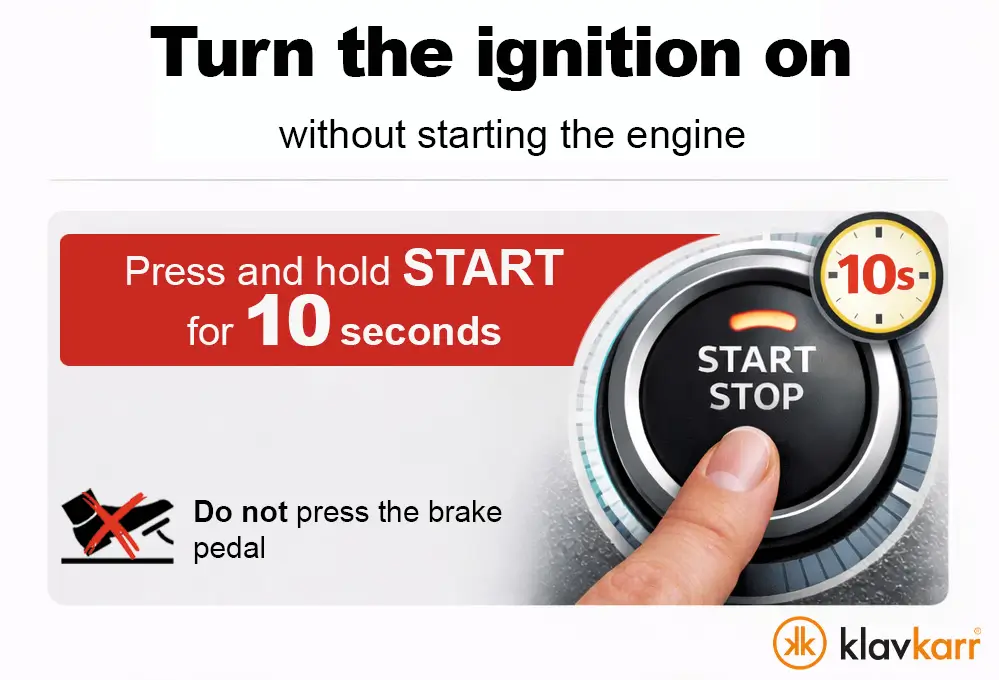
- Turn on your vehicle's ignition. For vehicles with keyless start, press the button for about 10 seconds without pressing the brake pedal to avoid starting the engine.
- Connect your klavkarr to the OBD port.
- Launch the application on your smartphone.
- Connect to your klavkarr.
- Select the brand: "Fiat".
- Select the model: "500, Ducato, Panda..."
- Choose the ECU: "ABS/ESP ECU" and click "Next".
- Go to "Diagnostics" then "Fault codes".
- Click "Clear" and confirm by clicking "Ok".
The ESC light no longer appears on your dashboard.
Important: if the actual fault is not repaired, clearing the fault code will not suffice. The light will automatically come back on as soon as the system detects the malfunction again during the next start or while driving.
FAQ - Clearing the Fiat ESC light
Why does the ESC light come on in my Fiat?
The ESC light can come on when the stability control system intervenes, for example, in case of traction loss. If the light stays on, it may indicate a fault related to an ABS sensor, the battery, the steering angle sensor, the tyres, the brake switch, or the Hill Holder system.
What is the difference between a flashing ESC light and a steady ESC light?
A flashing ESC light generally indicates that the system is actively stabilising the vehicle. This is common on slippery roads, during emergency braking, or in a curve taken too quickly. On the other hand, a steady ESC light most often signals a fault. In this case, a diagnostic is recommended.
Can you drive with the Fiat ESC light on?
It is possible to drive if the ESC light is on alone, the vehicle behaves normally, and no red light appears. However, drive cautiously, as the stability aid may be disabled or limited. If the ESC light is accompanied by the ABS, brake, engine, or power steering light, it is advisable to have the vehicle checked promptly.
How do you clear the ESC light on a Fiat?
The ESC light can be cleared with a compatible diagnostic tool after reading and clearing fault codes. However, you should not just clear the light: if the cause of the issue is not repaired, the light is likely to come back on quickly. Diagnostics help identify the exact origin of the fault before any intervention.
Share this article